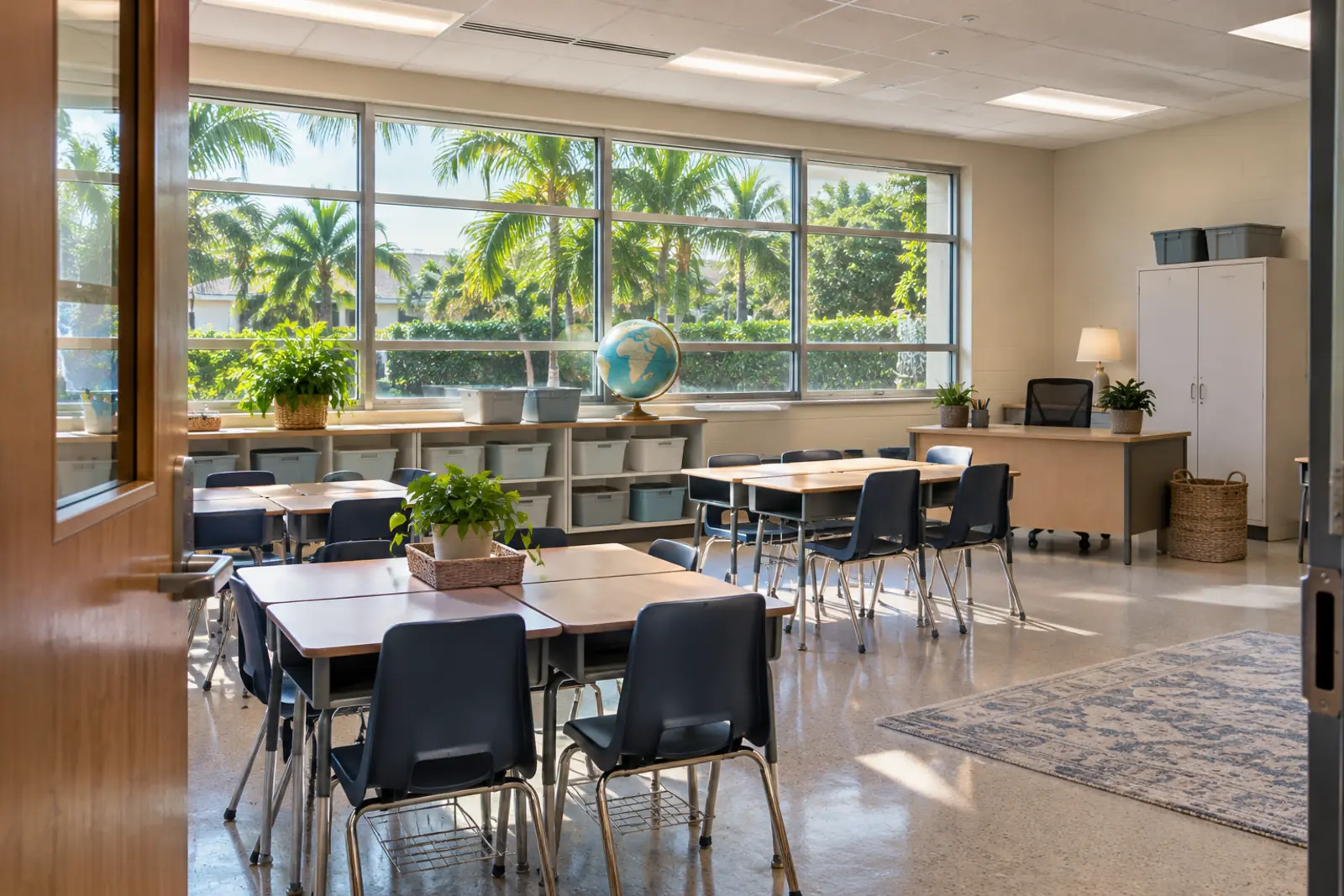
When families research a move to the Orlando metro area, school quality frequently shapes the final decision more than commute times, restaurant options, or even housing prices. Orlando is not served by a single school district. It straddles four separate county systems, each with its own budget, leadership, academic profile, and specialized programs. Choosing the wrong side of a county line can mean the difference between an A-rated school and one that is still working toward improvement. Meanwhile, Florida's unusually broad school-choice laws mean that families who do their homework often have far more options than a simple address-to-school lookup suggests. This guide walks through what you actually need to know about each district, how the state measures school quality, and the tools that give Orlando families meaningful flexibility.
How Florida Grades Its Schools
Florida assigns every public school an A through F letter grade each year based on student performance data. The Florida Department of Education calculates these grades primarily from standardized test results, currently through the Florida Assessment of Student Thinking (FAST) program, which replaced the older Florida Standards Assessments. The grading formula weighs several factors: reading and math proficiency, learning gains (how much students actually grew during the year), the gains made by the lowest-achieving 25 percent of the student body, and graduation rates at the high school level.
A school earning an A is performing well across all those measures. An F school has struggled persistently across most of them. The grades are public and searchable on the FLDOE website, and you should always verify the most current year's grade there since ratings shift as schools gain or lose experienced teachers, leadership, and resources. Third-party platforms like GreatSchools.org aggregate state grades alongside parent and teacher reviews, which adds useful texture to the raw letter.
One nuance that every Orlando parent should understand: school grades reflect the student population as much as they reflect what the school does. A campus in a lower-income zip code often faces challenges that a letter grade cannot capture, including higher student mobility, greater need for English-language instruction, and resource constraints that more affluent districts do not share. Look at the overall grade, but also examine learning gains scores separately. A school that is growing its students at an above-average rate is doing something genuinely right, even when overall proficiency scores remain below the state average. That distinction matters when you are comparing schools across very different parts of the metro.
Orange County Public Schools: The Region's Biggest District
Orange County Public Schools, known as OCPS, is the school district for the City of Orlando and the surrounding unincorporated areas of Orange County. By student enrollment, it ranks among the ten largest school districts in the United States, serving well over 200,000 students across more than 200 schools. A district that size is not a monolith. The academic experience at a high-performing magnet school in the Dr. Phillips corridor looks nothing like that at a neighborhood school still working toward improvement in parts of east or west Orlando. Understanding where within OCPS you land matters enormously.
The strongest-performing traditional public schools in OCPS tend to cluster in certain geographic pockets. The southwest portion of the county, covering the Dr. Phillips, Windermere, and Horizon West areas, is home to several highly rated elementary and middle campuses that feed into Dr. Phillips High School. That school has long been regarded as one of OCPS's flagship high schools, with a broad range of AP courses, competitive athletics, and a community deeply invested in student outcomes. Families looking at homes in the 32819 and 32836 zip codes are generally entering this attendance zone.
The Lake Nona area in the southeast has transformed over the past decade from undeveloped land into one of Orlando's most planned and invested communities. Lake Nona High School has benefited from newer facilities, a growing professional parent base drawn to the medical and tech employers in that corridor, and consistent attention from the district. Schools feeding into it at the elementary and middle levels have followed a similar upward trajectory.
Winter Park sits within Orange County's boundaries and sends students to Winter Park High School, a campus with a strong academic reputation, an active alumni network, and a location that makes it a natural draw for families buying in the Winter Park or Maitland areas. The school consistently posts graduation rates and college-going rates that rank among the district's best.
Central and west Orlando neighborhoods feed into schools including Colonial High, Evans High, and Edgewater High. These schools serve diverse communities with genuinely mixed outcomes. Some programs within them are excellent. The OCPS fine and performing arts magnet program housed at Edgewater, for instance, has produced professional-level musicians, dancers, and visual artists for many years and draws talented students from across the county. Jones High School in west Orlando holds significant cultural importance as one of Florida's historically Black high schools, with a committed alumni community and a history that matters to many longtime Orlando families.
OCPS Magnet Programs: The District's Hidden Asset
Where OCPS genuinely stands apart for families who research carefully is its magnet program network. The district operates magnet programs at dozens of schools spanning themes including fine and performing arts, science and engineering, medicine and health sciences, International Baccalaureate, law and public safety, technology, and more. Admission to most programs is competitive and requires a formal application. Some programs use a lottery for eligible applicants and others weigh grades or other criteria, but acceptance places your child in a specialized academic environment regardless of what your neighborhood school's overall rating looks like.
IB programs, available at a handful of OCPS high schools, prepare students for internationally recognized diplomas that carry significant weight in university admissions offices. Students who complete the full IB diploma often enter college with substantial credit already earned. Science and engineering magnets have strong track records of sending graduates into STEM-focused degree programs at high rates. The practical implication for relocating families is significant: a family that plans ahead and applies to a magnet program has far more flexibility in choosing where to live in Orange County than one relying solely on neighborhood school assignment.
The OCPS magnet application window typically opens in late fall, often in November or December, for the following school year. Families who are planning a move to Orlando should track that window carefully, because missing it means waiting another full year for a placement. Bookmark the OCPS Magnet Program page and check it each October so the deadline does not sneak past you.
Seminole County Public Schools: The High Achiever Next Door
Seminole County Public Schools serves the communities north and northeast of Orlando, including Sanford, Lake Mary, Longwood, Altamonte Springs, Casselberry, Oviedo, and Winter Springs. The district is considerably smaller than OCPS but has consistently ranked among Florida's top-performing school districts for academic outcomes across multiple years and multiple administrations. For families who prioritize district-wide consistency over access to a specific magnet program, Seminole County is often the first conversation they have when comparing Orlando-area options.
The floor is higher here. Even schools in Seminole County that do not top the state rankings tend to perform solidly. Lake Mary High School and Oviedo High School have both maintained graduation rates and college-going rates well above state averages for years, and they regularly send strong cohorts of students into competitive universities in Florida and nationally. Seminole High in Sanford and Winter Springs High round out a high school lineup that is uniformly respectable without requiring families to game attendance zones or lottery applications.
Elementary and middle schools across the district tend to reflect the same pattern. The district has a strong tradition of gifted and advanced coursework at every grade level, and the community culture around schools, parent involvement rates, and per-pupil funding have historically supported that performance. Families relocating from other high-performing suburban districts around the country often feel that Seminole County matches what they are used to more closely than any other option in the metro.
The trade-off is geography and commute. Living in Seminole County generally means driving into Orlando for work, which can be painful along the I-4 and State Road 434 corridors during peak hours. The SunRail commuter train does connect Sanford and several other Seminole County stations southward to downtown Orlando, which helps some commuters avoid the highway entirely. Families who work in the Lake Mary tech and corporate corridor, or at the many large employers along the I-4 spine between Altamonte Springs and Longwood, often find that Seminole County works naturally for both work and school quality without requiring any real compromise. Those who need to reach downtown Orlando or UCF daily should map that commute at rush hour before committing to an address.
Seminole County also operates magnet and specialized programs, including an IB pathway, Cambridge AICE programs, and career and technical education academies across multiple high schools. Gifted programs at the elementary level are well-established. Check the Seminole County Public Schools website for current program offerings and enrollment timelines, as these details change from year to year.
Osceola County Public Schools: A Growing District in Transition
Osceola County lies south of Orlando, encompassing Kissimmee, St. Cloud, Poinciana, and the master-planned community of Celebration. The district has grown rapidly as population pressure from Orange County has pushed families southward in search of more affordable housing and larger lots. That growth has strained resources and created a district that is investing heavily in improvement while managing a fast-expanding student body and a student population with significant diversity of needs.
Osceola County as a whole tends to score below both Orange and Seminole counties on state assessments, but the picture within the district is uneven and individual school research matters more here than it does in Seminole County. Celebration High School serves the Celebration community and has built a positive academic reputation among families who have settled in that planned development. Harmony High School in the St. Cloud area has similarly developed a solid standing, particularly for families in the newer subdivisions east of Kissimmee. Both schools reflect communities with relatively high engagement from parents who moved there intentionally and were already thinking about school quality when they chose their neighborhood.
Families considering addresses in Kissimmee proper, Poinciana, or the western parts of the county should look at individual school grades on the FLDOE site and, where possible, visit campuses before settling on a neighborhood. Do not rely on district-wide impressions when the internal variance is this significant. The county has been actively expanding its career and technical programs and adding specialized tracks in healthcare and technology fields that align with regional job growth, which is promising for students interested in those pathways.
Lake County Schools: The Western Option
Lake County sits directly west of Orange County, covering Clermont, Minneola, Groveland, Eustis, Tavares, Mount Dora, and Leesburg. The district is smaller than OCPS or Seminole County but has grown considerably as the Clermont and Minneola areas have become popular with families priced out of western Orange County. New housing developments around US-27 and the Turnpike interchange have brought a steady influx of young families who are beginning to shape the culture and expectations around local schools.
South Lake High School in Groveland serves the fast-growing communities around Clermont and has developed a positive reputation among families in that part of the county. East Ridge High in Clermont is another option for families in the eastern corridor. Overall district performance sits near the state average, with individual schools performing stronger or weaker depending on the community they serve and the resources available to them.
The commute consideration is critical for Lake County. Clermont to downtown Orlando via US-192 or the Florida Turnpike can stretch well past 45 minutes during morning rush hour, and that time grows longer as Clermont's own traffic increases. Families who work in the western Orange County area, near Winter Garden, Ocoee, or the attractions corridor, may find Lake County geography manageable with a reasonable commute. Those who need to be in downtown Orlando, at UCF, or at Lake Nona's medical city daily should calculate that commute honestly before committing to a Lake County address.
Florida School Choice: More Options Than Most Families Realize
One of the most important facts about Florida education that relocating families frequently miss is that the state operates under some of the broadest school-choice laws in the country. You are not simply locked into whatever neighborhood school corresponds to your address. Understanding the tools available to you changes the conversation entirely.
Open Enrollment and Inter-District Transfers
Within most Florida districts, open enrollment allows students to apply to attend a school outside their assigned attendance zone as long as space is available. Orange County, Seminole County, and Osceola County all maintain open enrollment processes with their own timelines and approval procedures. Approval is not guaranteed, popular schools fill quickly, and transportation is typically the family's responsibility, but families who apply early in the process often succeed in placing children at preferred campuses. Some districts also allow inter-district transfers, meaning a family living in Orange County can sometimes enroll a child in a Seminole County school if approved by both districts. That process has more steps and is less predictable, but it happens.
Charter Schools
Florida is home to one of the largest charter school sectors in the nation, and the Orlando metro reflects that fully. Charter schools are publicly funded and tuition-free, operating under a charter granted by the local school board while maintaining greater independence over curriculum, staffing, and culture than traditional district schools. Quality varies considerably. Some Orlando-area charters outperform their district counterparts consistently, while others fall well short. Research any charter school the same way you would a traditional public school: look at its current FLDOE grade, read parent reviews on GreatSchools, and if possible speak with current families whose children are enrolled.
Some charters specialize in educational approaches that appeal to specific families, including Montessori methods, classical curricula that emphasize great books and rhetoric, STEM integration, or arts. Enrollment in charter schools is typically by lottery, with preference given to siblings of current students. Application deadlines can fall as early as January or February for the following school year, so families planning a summer move to Orlando need to research charter options before they arrive, not after.
The Family Empowerment Scholarship Program
Florida's Family Empowerment Scholarship (FES) program provides state-funded scholarships for students to attend private schools or receive educational services including tutoring and therapies. The program operates along two tracks. One track serves students with disabilities or unique learning needs (FES-UA), and the other is income-based and open to a broader range of families (FES-EO). Step Up For Students, a scholarship-funding organization, administers the income-based program. The program has expanded significantly since its inception and now serves a substantial number of Florida families.
Eligibility income thresholds and scholarship amounts change as the program grows and state legislation adjusts it, so verify current figures at the Step Up For Students website or fldoe.org before making financial decisions based on this program. The key point for families relocating to Orlando is that a genuine private school pathway with partial or full state funding exists if you qualify, and many families who assumed private school was financially out of reach have found that this program changes that calculation meaningfully.
Practical Steps for Researching Schools Before You Move
The best school research happens well before you sign a lease or make an offer on a home. A reliable sequence looks like this.
Start with the Florida Department of Education school search tool at fldoe.org. Enter a school name or browse by district to see the most recent school grade, enrollment figures, and demographic data. Cross-reference with GreatSchools.org for parent reviews and a broader perspective. The two sources together give you a more complete picture than either one alone.
Use each district's address lookup tool to confirm precisely which schools a specific property feeds into. Do not assume based on zip code alone, because attendance boundaries sometimes cut across zip codes in non-obvious ways. OCPS, Seminole County, Osceola County, and Lake County all offer boundary lookup tools on their official websites, and these tools are updated when boundaries change. A street address that fed into School A last year might feed into School B this year if the district redrew lines to manage enrollment.
If a magnet or charter school enrollment is part of your plan, map out application deadlines before you finalize your move date. A family that arrives in Orlando in March expecting to enroll a child in a sought-after OCPS magnet program may discover that the application window closed the previous December. Timing your move around the school calendar and program application windows is worth the effort of planning ahead.
Visit schools in person when possible. Florida schools are generally accessible for tours during the school day, and many principals welcome prospective families. A 30-minute campus visit tells you things that no website can convey, including the culture, the energy in the hallways, how students interact with each other and with adults, and whether the environment feels like a good fit for your child's learning style and temperament. A strong school grade and a strong school feel should ideally point in the same direction. When they diverge, pay attention to why.
Special Considerations for High School Students
Families moving to Orlando with students already in high school face additional pressure because grade credits and course sequences need to transfer cleanly. Florida follows a standard course numbering system that makes most credits portable between Florida districts without loss, which helps significantly. Advanced coursework like IB and Dual Enrollment can be more complicated to continue if a move disrupts a sequence that is already underway, and it is worth a direct conversation with the receiving school's counseling department before the move happens rather than after.
Dual Enrollment is widely available across Orlando-area districts and allows high school juniors and seniors to take community college or state university courses at no cost to the family, earning both high school and college credit simultaneously. Valencia College partners with OCPS and Osceola County. Seminole State College partners with Seminole County. Lake-Sumter State College partners with Lake County. If a student is already in a Dual Enrollment sequence at another Florida institution, confirm with the receiving district that the credits will articulate correctly with their graduation requirements before the move is finalized.
Advanced Placement courses are offered at virtually every Orlando-area high school and are generally more portable than IB for families who anticipate further moves, since AP credit is accepted at universities nationally. OCPS, Seminole County, and most other districts in the metro actively expand their AP offerings each year to meet growing demand from families who expect that pathway for their students. If a student is already preparing for specific AP exams, confirm that the same courses are available at the receiving school with enough instructional time remaining to be ready for the May exams.
Students with individualized education programs (IEPs) or 504 plans require particular attention during a school transition. Florida schools are required to honor an existing IEP and implement services without undue delay when a student transfers from another Florida district, but the practical mechanics of that handoff vary by campus and district. Families of students with IEPs should contact the special education department of the receiving district before the move and request a meeting to review the existing plan as soon as enrollment is complete.
Frequently Asked Questions
Which Orlando-area school district is considered the best overall?
Seminole County Public Schools has historically posted the strongest district-wide academic performance in the Orlando metro, consistently ranking among Florida's top districts for graduation rates and student achievement across multiple years. That said, best depends on your family's specific priorities. Orange County's magnet network gives determined families access to specialized, high-performing environments regardless of their neighborhood school's overall rating, so research at the individual school level rather than stopping at the district level for the most useful comparison.
Can I send my child to a school outside my assigned attendance zone?
Yes, in most cases. Florida's open enrollment laws allow families to apply for transfers to schools outside their assigned zone within a district, subject to space availability. Some districts also permit inter-district transfers across county lines. Charter schools operate entirely outside attendance zone restrictions, funded publicly but with open application processes. Apply as early as possible since popular schools and programs fill quickly, and late applications often go on a waiting list with little realistic chance of placement before the school year begins.
How do I look up the current rating for a specific Orlando school?
Use the Florida Department of Education school search tool at fldoe.org to find the most recent letter grade and performance data for any public school in the state. Cross-reference with GreatSchools.org for parent reviews and a broader rating perspective that includes community feedback. Always verify the year of the data you are reading, because school grades update annually and can shift meaningfully from one year to the next as leadership, staffing, and community conditions change.
Are there good public school options in the Kissimmee and Osceola County area?
Yes, though quality is more varied than in Seminole County and individual school research matters more here. Celebration High School and Harmony High School in the St. Cloud area have both built solid academic reputations, and they serve communities with engaged parent populations. Quality varies considerably by specific campus within Osceola County, so families moving to that area should look up individual school grades and visit campuses before choosing a neighborhood rather than relying on district-wide impressions alone.
What is the Family Empowerment Scholarship and who qualifies?
The Family Empowerment Scholarship is a Florida state program that provides funding for qualifying students to attend private schools or access educational services like tutoring and therapies. One track serves students with disabilities or unique learning needs, and another track is income-based and administered by the nonprofit Step Up For Students. Eligibility thresholds and scholarship amounts change as the program grows and legislation adjusts it, so verify current qualification criteria at the Step Up For Students website or fldoe.org before making financial plans that depend on this funding.
When do magnet school applications typically open in Orange County?
Orange County Public Schools typically opens its magnet program application window in late fall, often in November or December, for the following school year. Specific dates change each year, so bookmark the OCPS Magnet Program page and check it each October if you plan to apply. Missing the application window means waiting a full year for the next cycle, which makes advance planning particularly important for families who are relocating to Orlando and want a magnet placement in place before their child's first day in the district.
Choosing a home in Orlando while accounting for school quality is genuinely complex, but that complexity works in favor of families who research carefully and plan ahead. The combination of open enrollment, a robust magnet program network, tuition-free charter schools, and the Family Empowerment Scholarship for qualifying families means the options extend well beyond whatever school happens to correspond to your street address. Start that research months before a planned move, track application windows, visit campuses in person, and connect with other families already in the areas you are considering. The investment in that process pays dividends for years.
Have questions about life in Orlando or want local insight before making your move? The Orlando Headlines team covers the city closely. Visit our contact page to reach us directly.